ESA report finds LEO collision risk worsened tenfold in a year
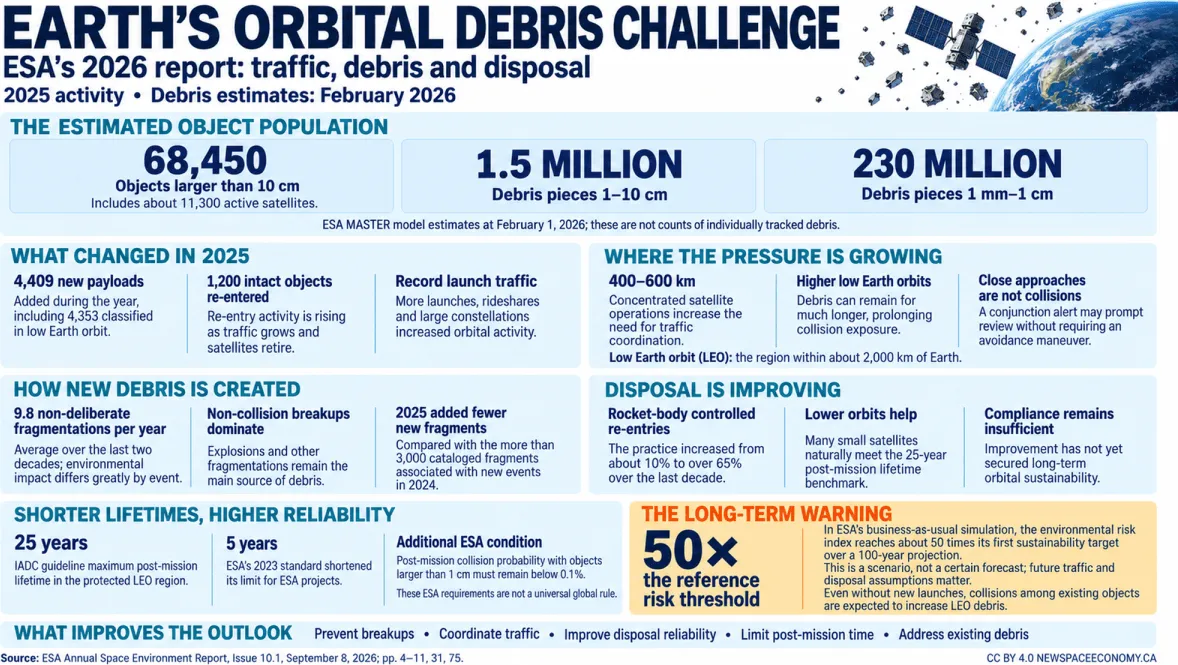
ESA's 2026 Space Environment Report finds its debris Health Index worsened tenfold in a year as megaconstellations keep expanding.
what happened
ESA's Space Environment Report 2026, published Sept. 14, found the agency's Space Environment Health Index jumped from about 4 to 50 in one year and lowered its prediction horizon for expected low-Earth-orbit collisions from 200 to 100 years. The agency says roughly ten new payloads launch daily and more than three intact satellites or rocket bodies reenter daily on average, with over 300 launches and more than 4,000 new payloads deployed in 2025, and it cites continued growth in the number and scale of commercial satellite constellations as satellites spread across wider altitude bands.
why it matters
ESA's own worsening risk metrics give commercial operators a harder data point for collision-avoidance and deorbit-compliance planning, and the report's explicit framing of megaconstellation growth as a driver adds pressure on large constellation operators, Starlink, Guowang, Qianfan and Kuiper among them, to demonstrate responsible deorbit practices as regulators weigh future debris rules.
signal-to-noise
quick facts
- Companies
- European Space Agency
- Category
- financial
- Impact
- notable
- SNR
- 5 / 5
- Event date
- 2026-09-14
- Published
- 2026-09-14 13:37 UTC