JAXA launches MMX sample-return mission toward Mars moon Phobos
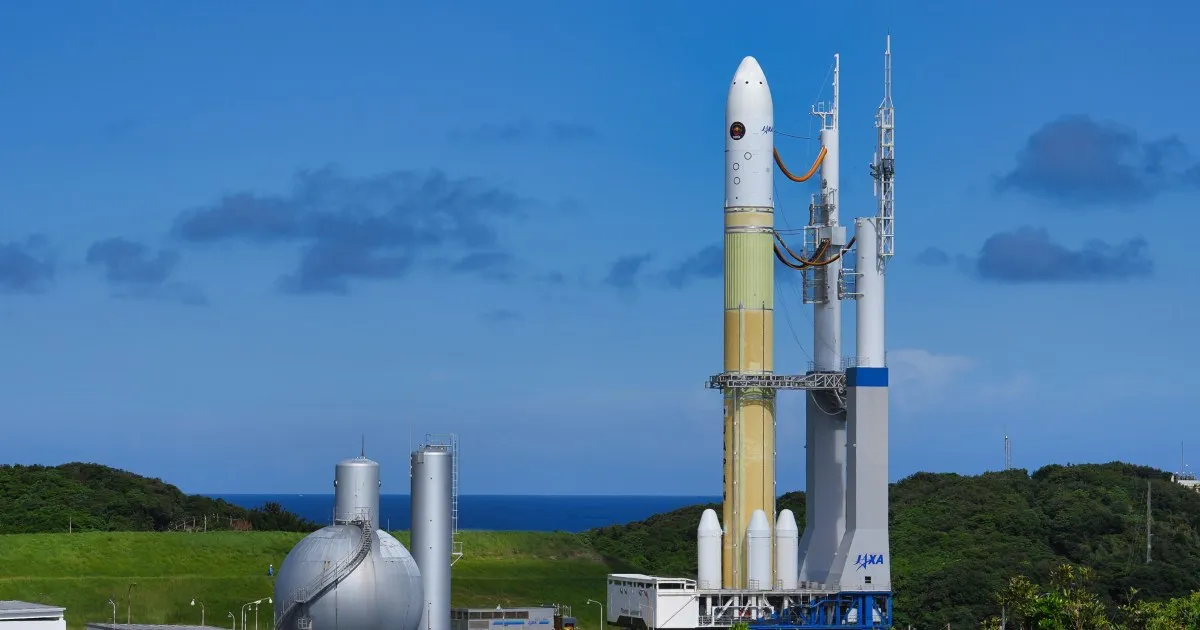
JAXA's H3 rocket lifted off carrying MMX, Japan's first interplanetary mission and first attempt to return a sample from a Martian moon.
updates
- 2026-10-21JAXA confirms MMX completed its initial critical operations phase on Oct. 21: solar arrays deployed, three-axis attitude control established, and the spacecraft confirmed healthy.
- 2026-10-20score 4 → 5JAXA's own post-launch release confirms MMX separated from the H3 upper stage 71 minutes and 13 seconds after liftoff and was injected into its planned trajectory, upgrading the lead from whitelisted trackers to JAXA's own confirmation.
what happened
JAXA's H3 flight 10 lifted off from Tanegashima Space Center at 19:41 UTC Oct. 19 (4:41 a.m. JST Oct. 20) carrying the Martian Moons eXploration (MMX) spacecraft, per Marcia Smith of SpacePolicyOnline and Anatoly Zak of RussianSpaceWeb, both posting on Bluesky, Launch Library, and JAXA's own post-launch press release. JAXA's release states the H3 vehicle "flew as planned" and confirms MMX separation 71 minutes and 13 seconds after liftoff, with the spacecraft injected into its predetermined orbit; per TechEBlog, the spacecraft weighs roughly 4,480 kilograms. MMX is headed toward Phobos and Deimos, carrying 13 scientific instruments including two from the US and one from France's CNES and Germany's DLR, per Smith; Zak called it "humanity's 54th mission to the Red Planet." MMX is expected to arrive at Mars in August 2027, collect a Phobos sample no earlier than 2029-2030, and return it to Earth in 2031. JAXA said Oct. 21 that MMX completed its initial critical operations phase, the sequence from launch vehicle separation through solar array paddle deployment, establishing three-axis attitude control, and releasing the medium-gain antenna's hold-down mechanism, confirming the spacecraft is in good health; JAXA will next run initial functional checks on the spacecraft's onboard equipment ahead of its cruise toward the Martian system.
why it matters
A successful launch and separation retires the near-term risk on JAXA's first interplanetary use of its flagship H3 rocket and its first attempt at an interplanetary sample return, both of which the agency has been rebuilding credibility for after H3's earlier delays and failures; a clean flight supports confidence in H3's manifest for the commercial and government payloads still queued behind it.
for who
Japanese launch-vehicle watchers and planetary science mission planners