STAR.VISION unveils Marco Polo and Ibn Battuta orbital AI-compute satellites
STAR.VISION · Uzcosmos
STAR.VISION's dual-satellite demo, launching this quarter, will run Alibaba's Qwen3.5 model on a 10-petaOPS orbital compute platform.
what happened
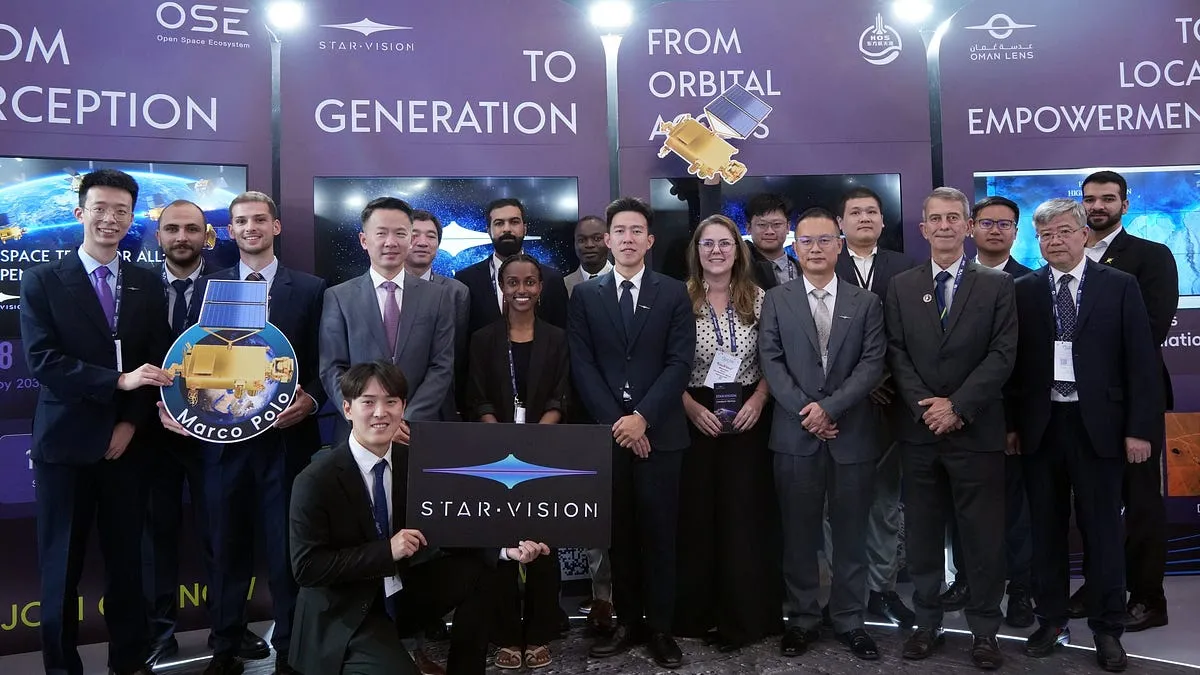
STAR.VISION announced on October 5 that it will launch a dual-spacecraft on-orbit compute demonstration, named Marco Polo and Ibn Battuta, into sun-synchronous orbit this quarter, per China in Space. The two satellites will connect via a 100 gigabit-per-second laser link; Marco Polo will run Alibaba Cloud's 397-billion-parameter Qwen3.5 model for AI inference and decision-making, while Ibn Battuta carries a ten petaOPS compute platform. At the International Astronautical Congress in Antalya, the company also signed cooperation agreements on orbital compute and research with Uzbekistan's Uzcosmos on October 7 and Zimbabwe's National Geospatial and Space Agency, and agreed partnerships with Egypt's, Brazil's, and Kenya's space agencies and with Oman.
why it matters
The announcement extends China's push toward orbital AI compute beyond onboard image processing, following STAR.VISION's existing Lampung-1/Samarkand-2028 hyperspectral fleet, and gives the company government partners across Central Asia, Africa, and the Gulf to pitch tasking and compute services to. It is an early marker of Chinese satellite operators hosting commercial large language models in orbit rather than just edge inference.
signal-to-noise
quick facts
- Companies
- STAR.VISION, Uzcosmos
- Category
- product
- Impact
- notable
- SNR
- 3 / 5
- Event date
- 2026-10-05
- Published
- 2026-10-13 14:52 UTC